Table of Contents
- What Can I Recycle At Currys For Free?
- What You Usually Can’t Recycle At Currys (And Why)
- Do You Need To Buy Something To Recycle At Currys?
- How To Find A Free Currys Recycling Point Near You
- How To Prepare Items Before Recycling (Quick Checklist)
- Alternatives If Currys Isn’t Convenient
- FAQs: Currys Recycling
- Fun Fact: Old Chargers Are A Mini Metal Mine
- Conclusion
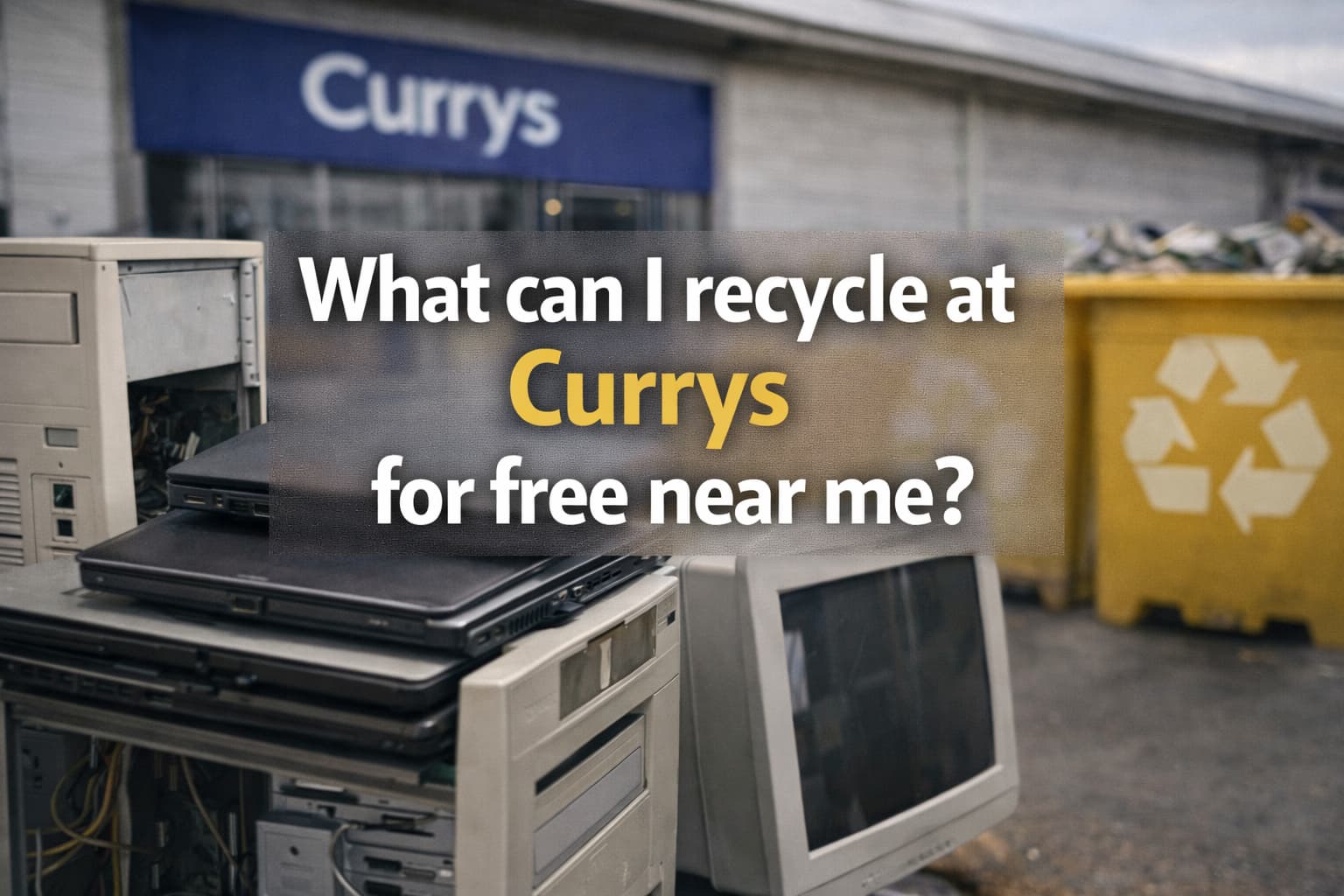
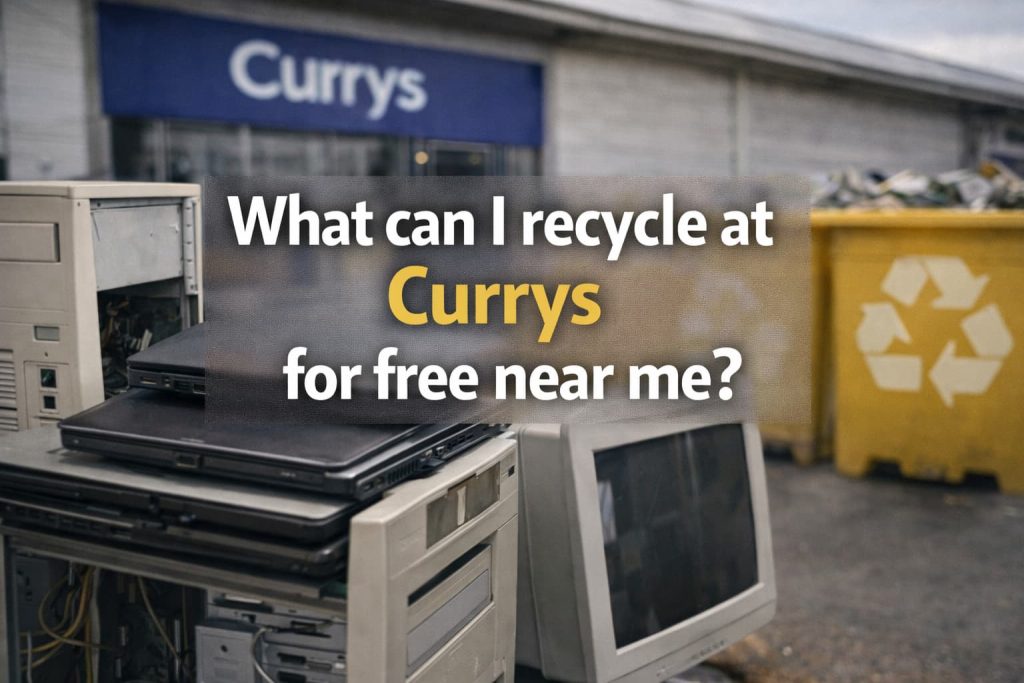
Currys often lets you recycle many household electrical items for free in-store, including small electricals (such as cables, chargers, keyboards, kettles and hairdryers) and, in many branches, batteries via collection points. Larger appliances and TVs may be accepted under specific conditions or local store schemes. Use the Currys store finder to check what your nearest branch accepts before you travel.
If you have a bag of old cables, a dead kettle, or a box of IT kit from a home office clear-out, it is normal to want one simple answer: “Can I drop this at Currys for free near me?” In practice, Currys recycling can vary by branch, item type, and whether you are dropping off in-store or arranging collection when buying a replacement. This guide gives you a clear UK checklist so you can avoid a wasted trip and recycle safely and legally.
Accuracy note: Retailer takeback schemes can change, and participation may differ by store. Always check your local branch’s latest guidance (via Currys’ store finder and in-store signage) before you travel.
Methodology note: This article is based on UK WEEE rules, consumer guidance from UK recycling bodies, and common retailer takeback practices. For the legal framework, see GOV.UK WEEE guidance.
What Can I Recycle At Currys For Free?
Many Currys stores offer free in-store drop-off for smaller electrical items. Many also provide battery recycling collection points. Some larger items may be accepted through specific takeback routes, for example, when a replacement is delivered, or via store-led schemes. The safest approach is to check locally first, as not every branch accepts every category.
Small Electricals You Can Usually Recycle In-Store (Common Examples)
“Small electricals” generally means items that plug in or use a battery and are easy to carry into the shop. Examples that are commonly accepted for free drop-off include:
- Kitchen and household smalls: Kettles, toasters, microwaves, blenders, irons, vacuum accessories.
- Personal care devices: Hairdryers, straighteners, electric shavers, electric toothbrushes (handle units).
- Audio and media kit: Radios, small speakers, set-top boxes, streaming devices.
- Networking and accessories: Routers, modems, docks, hubs, adaptors.
If you are unsure whether your item counts as WEEE, look for the crossed-out wheeled bin symbol on the product or packaging. It indicates the item should not go in general waste.
Batteries And Accessories (Cables, Chargers, Remotes): What’s Normally Accepted
Many Currys stores have battery collection points, often near the entrance or customer service. Items that are typically accepted include:
- Household batteries: AA, AAA, C, D, 9V, and button batteries.
- Device accessories: Cables, chargers, remotes, and small power supplies.
- Small rechargeable batteries: From consumer electronics, as long as they are safe and intact.
Safety warning for lithium batteries: Do not bring swollen, leaking, damaged, or hot batteries into any shop. Damaged lithium batteries can pose a serious fire risk. Your local council Household Waste Recycling Centre (HWRC) may have a safer process for hazardous items, or they may advise a specialist route.
For general consumer guidance on what counts as an electrical and why recycling matters, see Material Focus, Recycle Your Electricals.
Computers, Laptops And Peripherals: What To Expect
Many people use Currys drop-off for IT-related items, but acceptance can vary depending on store capacity and local schemes. Items that are often accepted include:
- Computers and laptops: Including broken units.
- Monitors and peripherals: Screens, keyboards, mice, speakers, webcams.
- Printers and scanners: Often, the device itself, but ink and toner are not always accepted.
Plan for data security: If your device stores personal or business data, wipe it before you hand it over. If you need formal assurance for work equipment, a specialist service that provides documentation may be more suitable. Green Retech Recycling explains safer routes for IT disposal here: What’s The Safest Way To Dispose Of Old IT Equipment?
Large Appliances, TVs And Fridges: When Free Recycling May Still Apply
Larger items can be difficult to handle in-store due to space, lifting equipment, and health and safety rules. In many cases:
- TVs and large screens: May be accepted in some locations or via specific takeback arrangements.
- Washing machines, cookers, dishwashers: Are often handled via delivery takeback when you buy a replacement, rather than as a walk-in drop-off.
- Fridges and freezers: Usually require specialist treatment due to refrigerant gases. They are commonly managed through delivery takeback or council HWRCs with designated areas.
If you are dealing with bulky items, compare your options. A council HWRC, a retailer collection, or a dedicated collection service may be easier than moving heavy appliances yourself.
What You Usually Can’t Recycle At Currys (And Why)
Even where free recycling is available, there are common exclusions. These are usually linked to safety, contamination risk, or the item not being covered by a local in-store scheme.
Hazardous Or Restricted Items (Examples And Safer Alternatives)
- Damaged lithium batteries and vapes: These can pose a fire risk. Ask your council HWRC for guidance, or use a dedicated battery recycling point that can safely handle the item’s condition.
- Loose chemicals or fuel-contaminated items: For example, equipment with leaking liquids or fuel residue.
- Medical or clinical devices: Some devices require specialist handling depending on prior use and contamination risk.
- Very large commercial quantities: Shop drop-offs are designed for household volumes, not large office clearances.
If you want a clearer view of what is and is not covered under WEEE, Green Retech Recycling has a useful explainer: Which Items Are Not Covered Under WEEE Regulations?
Packaging, General Waste And Non-Electrical Items
- Cardboard, polystyrene, mixed packaging: Use household kerbside recycling where available, or your local recycling centre.
- General waste: Shops are not set up as general waste facilities.
- Non-electrical items: For example, furniture, textiles, or toys without electronics.
Remember, electrical items should not be put in the bin. For the legal and practical reasons, see Can WEEE Items Go In The Bin?
Do You Need To Buy Something To Recycle At Currys?
Often, you can recycle certain small electrical items for free without buying anything. However, this can vary by store and by item type. For large appliances, free takeback is more commonly linked to buying a replacement with delivery, as the old unit can be collected at the same time.
WEEE Retailer Takeback Explained In Plain English
The UK’s WEEE system is designed to keep electrical waste out of general waste and ensure it is treated correctly. Retailers and producers have obligations, and many retailers offer takeback routes to make recycling easier. In simple terms:
- If you are replacing an item: You can often hand over the old like-for-like item through a takeback route, frequently at delivery or via an arranged service.
- If you are not buying: Many stores still accept smaller WEEE items in-store, but participation can vary.
- If the item is hazardous or very large: You may be directed to a council HWRC or a specialist service.
For the official framework and definitions, refer to GOV.UK WEEE guidance.
How To Find A Free Currys Recycling Point Near You
If you are searching for “Currys recycle near me”, the quickest way to avoid wasted travel is to check what your nearest store is currently accepting.
Check Store Participation And Item Limits Before You Go
- Use Currys’ store finder: Check your nearest branch, opening times, and any local notes about recycling.
- Look for recycling point details: Check whether the store mentions in-store recycling, battery drop-off, or specific limits.
- Call ahead if you have an unusual item: This is particularly important for TVs, large screens, bulky appliances, or damaged items.
- Ask about quantity limits: Some stores may limit how much you can drop off in one visit.
If you are clearing a full home office or multiple machines, a collection with paperwork is often more efficient than several car trips. Green Retech Recycling explains what can be collected here: What Types Of Equipment Can You Collect?
What To Bring (ID, Proof Of Purchase, Or Nothing?)
For in-store drop-off of small electricals, you do not usually need ID or proof of purchase. Policies can vary, though. For a takeback linked to a new purchase, you may need:
- Order or delivery details: To match the old item to the replacement collection.
- Basic item information: Brand and type, especially for large appliances.
- Safe packaging where possible: To prevent loose parts or sharp edges during transport.
How To Prepare Items Before Recycling (Quick Checklist)
Preparation protects your data, prevents transport issues, and improves the chances of reuse or high-quality recycling.
Data Security For Phones, Tablets, Laptops And Computers
- Back up important files: Save photos, documents, and contacts before you wipe anything.
- Sign out of accounts: Remove devices from Apple ID, Google, Microsoft, and any workplace management tools.
- Turn off tracking and reset: Disable “Find My” features, then complete a factory reset.
- Remove storage where appropriate: If you are not comfortable leaving a drive in place, remove it or use a specialist data destruction service.
If you need formal assurance, for example, for business devices, Green Retech Recycling explains what happens to data and how certification works:
- What Happens To Data On My Old Computer Or Laptop?
- Will I Get A Data Destruction Certificate?
- Is Your Service Fully GDPR Compliant?
Remove Batteries, Ink/Toner And Accessories Where Possible
- Remove loose batteries: Especially AA and AAA types, then recycle them via a battery collection point.
- Leave embedded batteries if you cannot safely remove them: Do not force open casings.
- Remove ink and toner cartridges: Check whether your cartridge brand has a return scheme, as these are not accepted everywhere.
- Gather cables and chargers: These are commonly recyclable and contain recoverable metals.
Alternatives If Currys Isn’t Convenient
If there is no participating Currys branch nearby, or your item is not accepted, you still have several compliant options in the UK.
Your Local Council Recycling Centre (HWRC) And Kerbside Options
Most councils provide WEEE recycling at HWRCs. Some areas also offer kerbside collections for small electricals. Check your council website for:
- Accepted WEEE categories: Many sites separate small electricals, screens, and large appliances.
- Battery and light bulb points: These are often kept in designated containers.
- Booking requirements: Some HWRCs require time slots for vehicle access.
Other Retailer Takeback Schemes And Battery Drop-Off Points
Some supermarkets and DIY retailers provide battery drop-off points or small WEEE bins. To find nearby options, you can also use national guidance and locator tools from Material Focus.
For broader UK recycling best practice and waste reduction guidance, see WRAP (Waste and Resources Action Programme).
Free Collection For IT Equipment (Businesses And Households): When It’s A Better Fit
If you have multiple items, bulky IT, or you need documentation, collection can be easier than drop-off. This is often a better fit for:
- Office clear-outs: Multiple laptops, desktops, monitors, and peripherals.
- Compliance needs: Asset lists, chain of custody, and data destruction certification.
- Limited transport: If you cannot safely move equipment yourself.
Green Retech Recycling offers collection options and can advise whether you qualify for a free collection: Who Can Book A Free Collection? If you are a household with old computer equipment, start here: Can Households Use Your Computer Recycling Service?
FAQs: Currys Recycling
Can WEEE Items Go In The Bin?
No. Electrical items should not go in general waste because they can contain hazardous components and valuable materials that should be recovered. WEEE is designed to be collected and treated separately. For the legal framework, see GOV.UK WEEE guidance. For a plain-English explanation, read Can WEEE Items Go In The Bin?.
What Happens To Electronics After They’re Collected?
Routes vary, but compliant WEEE treatment often follows a similar path:
- Reuse first: Working items may be tested, refurbished, and reused where appropriate.
- Depollution: Hazardous parts (such as certain batteries, gases, or components) are removed for safe treatment.
- Materials recovery: Metals, plastics, and glass are separated and processed for recycling.
To understand the process in more detail, see How Is Electronic Waste Recycled?.
Can I Recycle Broken Items? Do They Need To Power On?
Yes, broken items are still classed as WEEE and can be recycled. They do not usually need to be powered on. What matters is safe handling. If an item is badly damaged, leaking, or has a swollen battery, a shop may refuse it for safety reasons and direct you to a council HWRC or specialist handler.
Fun Fact: Old Chargers Are A Mini Metal Mine
Many small electricals contain recoverable metals, including copper and aluminium, and sometimes tiny amounts of precious metals. Recycling a drawer full of old chargers and cables puts useful materials back into manufacturing, rather than losing them to landfill or incineration.
Conclusion
Currys can be a convenient option for free electrical recycling near you, especially for small electricals and batteries. However, acceptance can vary by branch and item type. Before you go, check your nearest store’s current guidance, pack items safely, and wipe data from anything that stores personal information.
If you have multiple IT items, need a documented audit trail, or want peace of mind about data handling, Green Retech Recycling can help with compliant recycling and collection options. Start with: What’s The Safest Way To Dispose Of Old IT Equipment?