Table of Contents
- What Does A Secure Data Destruction Company Do?
- Core Services Secure Data Destruction Companies Offer
- On-Site Vs Off-Site Data Destruction: Which Is Right For You?
- What Proof And Documentation Should You Expect?
- Security And Compliance Standards To Look For (UK)
- Which Service Should You Choose For Different Assets?
- Common Mistakes Organisations Make (And How To Avoid Them)
- Questions To Ask Before You Hire A Secure Data Destruction Company
- FAQ
- Fun Fact: One Hard Drive Can Create A Big Security Problem
- Conclusion
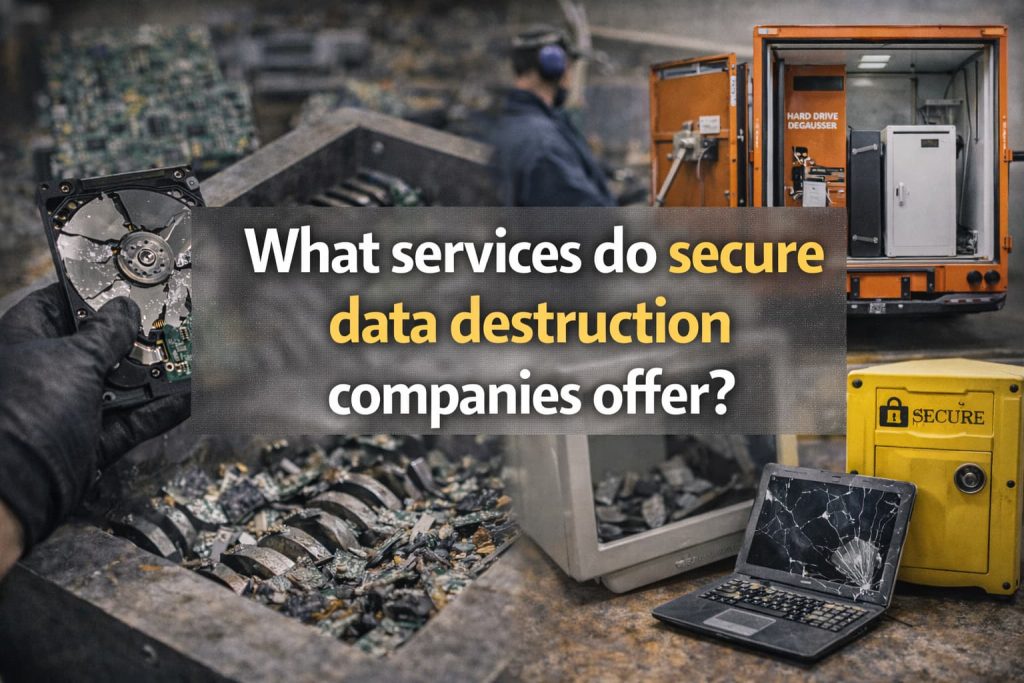
Secure data destruction companies typically offer secure collection, chain-of-custody handling, data wiping to recognised standards, physical destruction (shredding, crushing, degaussing) of drives and media, and compliant recycling of remaining equipment. Reputable providers also supply audit trails, serial number reporting, and Certificates of Data Destruction to support UK GDPR, retention policies, and internal compliance.
Whether you are clearing a cupboard of old laptops or decommissioning servers across multiple sites, the risk is the same. Data-bearing devices remain a security and compliance issue until you sanitise or destroy them, and keep clear evidence.
This guide explains the core services you should expect from a secure data destruction provider, how to choose between wiping and shredding, and what proof you need for audits.
If you would like a plain-English overview first, see what secure data destruction is. If you are ready to arrange a service, explore Green Retech Recycling secure data destruction or book a secure collection.
What Does A Secure Data Destruction Company Do?
A secure data destruction company helps organisations permanently remove data from devices and media. It then provides evidence that the work was carried out securely and compliantly.
In practice, this usually means:
- Reducing risk: Preventing data breaches from end-of-life IT, lost assets, or resale without sanitisation.
- Supporting compliance: Providing records that help you show appropriate security and disposal under UK GDPR and internal retention policies.
- Handling logistics securely: Controlling what happens from your site to final processing using chain-of-custody controls.
- Managing environmental obligations: Ensuring electrical waste is handled through compliant recycling pathways, not landfill.
A provider can support your compliance, but it cannot replace your own policies. You still need clear internal processes for approving disposals, authorising collections, and retaining evidence.
Core Services Secure Data Destruction Companies Offer
Secure Collection And Logistics (Locked Containers, Sealed Transport, Vetted Staff)
Secure collection is often where risk starts. Devices can go missing before they reach a shredder or a wiping station. A reputable provider will typically offer:
- Secure containers: Locked consoles or lidded bins for ongoing collections, or sealed cages for one-off clear-outs.
- Sealed transport: Vehicles loaded under supervision, with sealed or controlled compartments.
- Trained and vetted staff: Personnel who know how to handle data-bearing devices and follow documented procedures.
- Controlled storage: Access-controlled holding areas if items are staged before processing.
For multi-site organisations, collections can be scheduled by location and risk tier. If you need help aligning collections with your wider disposal programme, Green Retech Recycling IT asset disposal (ITAD) can bring collection, reporting, and downstream processing together.
Chain Of Custody And Asset Tracking (Barcodes, Serial Numbers, Tamper-Evident Seals)
Chain of custody is the set of controls and records that show who had an asset, where it was, and what happened to it at each step. You should expect tracking such as:
- Asset identification: Scanning barcodes and recording manufacturer serial numbers for laptops, desktops, servers, and drives.
- Tamper-evident sealing: Seals on containers or cages, with seal IDs recorded at handover and receipt.
- Handover documentation: Collection notes signed by your authorised staff and the provider’s team.
- Access control and CCTV: Controls in storage and processing areas, where available, to deter and investigate incidents.
This is especially important in regulated environments such as finance, healthcare, legal, education, and the public sector. In these settings, auditability matters as much as the destruction method.
Data Wiping And Sanitisation (Software Erasure For Re-Use)
Data wiping (also called secure erasure or sanitisation) uses software and verification to remove data so equipment can be re-used, resold, or donated. A professional data wiping service typically includes:
- Method selection: Choosing an erasure method that fits the device type and risk level.
- Verification: Post-wipe checks to confirm the wipe completed successfully.
- Reporting: Logs linked to asset IDs, often with pass or fail outcomes and time stamps.
Many organisations choose wiping for devices that will have a second life. If you are planning to recycle equipment, you may also want to read how to clear an old computer before recycling for internal preparation steps.
For technical guidance on sanitisation categories and verification approaches, NIST’s well-known reference is NIST SP 800-88 Rev. 1.
Physical Destruction Of Drives And Media (Shredding, Crushing, Drilling)
Physical destruction is used when the media is end-of-life, when the risk is high, or when you cannot reliably wipe the device. Common methods include:
- Shredding: Drives and media are shredded into small fragments, often used for high assurance.
- Crushing: Drives are mechanically deformed, so platters or chips cannot be read.
- Drilling or punching: Holes are drilled through key components, usually as a lower-throughput method.
For many organisations, physical destruction is the simplest route to reduce uncertainty, especially for mixed batches of unknown devices. If your team is debating whether removing a drive is enough, see will removing the hard drive erase everything?
Degaussing For Magnetic Media (Where Appropriate)
Degaussing uses a strong magnetic field to disrupt data on magnetic media such as some HDDs and backup tapes. It is not appropriate for all media types.
- Best for certain magnetic media: Often used for tapes and some hard disk drives.
- Not suitable for SSDs: Solid-state drives store data differently and are not degaussed in the same way.
- Typically renders media unusable: Degaussed media is often not fit for reuse.
A good provider will explain where degaussing fits in, and when shredding or verified wiping is more suitable.
Secure Destruction Of Paper Records And Other Media (Optional Add-On)
Some secure data destruction companies also offer confidential paper shredding or destruction of other media types. If you need one supplier for multiple waste streams, ask whether they can handle:
- Paper and printed records: Confidential waste bins and scheduled collections.
- ID cards and badges: Secure destruction of PVC cards where required.
- Mixed media: A defined process for separating data-bearing items from general waste.
If you need paper destruction as part of a wider clear-out, confirm that reporting is still available. This matters when records relate to personal data.
WEEE-Compliant Recycling And Downstream Waste Management
After data is wiped or media is destroyed, the remaining equipment still needs to be processed safely and legally. In the UK, electrical and electronic waste should be handled under WEEE rules and your organisation’s Duty of Care.
- WEEE-compliant processing: Correct treatment routes for IT equipment, batteries, and components.
- Downstream management: Approved recycling partners and documented material flows.
- Duty of Care paperwork: Waste transfer notes and records showing where waste went.
For official guidance, see GOV.UK WEEE regulatory guidance and the Waste Duty of Care Code of Practice.
To understand the recycling side in more detail, visit Green Retech Recycling WEEE recycling or IT equipment recycling.
IT Asset Disposal (ITAD) Services (Testing, Refurbishment, Resale, Charitable Donation)
ITAD is the broader service layer that often sits around data destruction. If you want value recovery and structured reporting, ITAD services can include:
- Testing and grading: Assessing devices for re-use potential.
- Refurbishment: Preparing assets for redeployment or resale where appropriate.
- Resale or donation handling: Managing downstream transfer once data has been sanitised.
- End-to-end reporting: Asset registers, outcome codes (re-used, recycled, destroyed), and environmental notes.
If you are mapping a complete process, this guide to the IT asset management disposal process can help you set expectations internally.
On-Site Vs Off-Site Data Destruction: Which Is Right For You?
Both on-site and off-site services can be secure. The best choice depends on sensitivity, volume, logistics, and the level of assurance you need.
When On-Site Destruction Makes Sense (High Sensitivity, Strict Internal Controls)
- Highly sensitive data: Where your risk assessment says devices must not leave the site intact.
- Witness requirements: When stakeholders need to observe destruction for governance reasons.
- Complex internal approvals: When you have strict segregation of duties and want immediate sign-off.
On-site destruction can be reassuring, but you still need robust evidence. You also need safe handling of shredded residue afterwards.
When Off-Site Destruction Is Suitable (Volume, Cost, Scalability)
- High volumes: Large clear-outs are often processed more efficiently at a dedicated facility.
- Multiple locations: Consolidation can reduce cost and simplify reporting.
- Broader processing needs: Off-site facilities may combine destruction, recycling, and ITAD workflows.
The key is the chain of custody. If a provider cannot clearly explain secure handling from collection to processing, treat that as a red flag.
What Proof And Documentation Should You Expect?
Documentation turns a “we destroyed it” claim into audit-ready evidence. At a minimum, expect certificates and a report that ties outcomes to asset identifiers.
Certificate Of Data Destruction And What It Should Include
A Certificate of Data Destruction should be specific enough to help in an audit or investigation. Look for:
- Your organisation’s details: Site name, address, and reference number.
- Date and location: When and where destruction or wiping took place.
- Method used: For example, verified wiping, shredding, crushing, or degaussing.
- Asset identifiers: Serial numbers, asset tags, and drive IDs where applicable.
- Authorisation: Operator sign-off and, where relevant, witness sign-off.
Audit Trail Reporting (Asset Lists, Serial Numbers, Weights, Dates, Locations)
Good providers can supply an audit trail that you can store with your disposal records. This might include:
- Asset type: Laptop, desktop, server, HDD, SSD, tape, phone.
- Make and model: Useful for matching to internal asset management records.
- Serial number and asset tag: The core identifiers for proving what happened to each item.
- Outcome: Wiped for re-use, physically destroyed, or recycled.
- Time stamps: Collection time, receipt time, processing time.
- Processing location: Site address or facility identifier.
This is also where environmental reporting can sit, such as weights by category and recycling outcomes. For service expectations and policy references, see Green Retech Recycling policies.
Witnessed Destruction And Photo/Video Evidence (If Offered)
Some organisations prefer extra assurance. Depending on the provider and method, you may be able to request:
- Witnessed destruction: A nominated staff member observes the process and signs the confirmation.
- Photo or video evidence: Images of serial numbers, batches, or destruction events where appropriate.
- Exception reporting: A documented process if an item cannot be processed as expected.
Security And Compliance Standards To Look For (UK)
There is no single badge that guarantees security. However, there are common standards, guidance sources, and documents that show maturity and audit readiness.
GDPR And The UK GDPR/Data Protection Act 2018 Obligations
Under UK GDPR, organisations must process personal data securely and not keep it longer than necessary. Secure disposal is part of that lifecycle. The regulator’s guidance is available from the Information Commissioner’s Office (ICO).
- Practical expectation: You should be able to show appropriate technical and organisational measures for disposal.
- Evidence expectation: Certificates and reports support accountability, especially after incidents or during audits.
NCSC Guidance On Secure Sanitisation And Disposal
The UK National Cyber Security Centre provides guidance that supports risk-based decisions on device handling and disposal. See NCSC Device Security Guidance.
- Practical expectation: Choose sanitisation methods that match the sensitivity of the data and the threats you face.
- Process expectation: Control devices throughout the disposal journey, not only at the point of destruction.
ISO 27001, ISO 9001 And ISO 14001 (Common Management Standards)
Many mature providers align with management system standards that support repeatable processes:
- ISO 27001: Information security management, helpful for governance around access control, incident handling, and procedures.
- ISO 9001: Quality management, useful for consistent service delivery and corrective actions.
- ISO 14001: Environmental management, relevant for recycling operations and environmental impact controls.
Ask what certifications are current, what scope they cover, and whether they apply to the exact site handling your assets.
WEEE And Duty Of Care Documentation
Even after you destroy data, you still have legal responsibilities for the waste. Ensure you receive and retain:
- Waste transfer notes: Proof of transfer under Duty of Care.
- Clear downstream routes: Evidence that WEEE is treated appropriately.
- Records retention plan: A defined period for keeping disposal documentation.
Which Service Should You Choose For Different Assets?
Choosing between wiping, destruction, and degaussing should be based on media type, re-use goals, and your risk appetite.
Laptops, Desktops And Servers
- For re-use or resale: Verified data wiping with reporting, plus testing and grading if using ITAD.
- For end-of-life: Physical destruction of the drive, then recycle the chassis through WEEE pathways.
- For server decommissioning: Strong chain of custody and serial number capture, because quantities and component swaps can complicate audits.
Hard Drives Vs SSDs (Why Physical Destruction Is Often Preferred For SSDs)
HDDs and SSDs behave differently:
- HDDs: Often suitable for verified wiping or degaussing (where appropriate), with shredding used for high assurance.
- SSDs: Overwrite-based wiping can be less predictable on some SSDs due to wear levelling and controller behaviour. When you need maximum certainty, physical destruction is often preferred.
- Encrypted drives: If full-disk encryption is properly implemented and keys are securely managed, crypto-erase may be an option. You still need evidence and a risk-based decision.
If you are unsure what is in your device estate, many organisations default to destroying SSDs and wiping HDDs intended for re-use. However, the right answer depends on your policy and threat model.
Mobile Phones And Tablets
- Factory reset is not a disposal strategy: Treat it as a user step, not an audit-ready sanitisation method.
- Prefer verified processes: Choose wiping with reporting where possible, or physical destruction if devices are end-of-life.
- Remember accessories: SIMs, microSD cards, and removable storage need separate handling.
Back-Up Tapes, USBs And Optical Media
- Back-up tapes: Often destroyed or degaussed due to sensitivity and volume, with strong batch tracking.
- USBs: Small and easy to lose, so physical destruction is often the simplest option.
- Optical media: Discs may require shredding or specialist destruction methods, depending on the provider.
Common Mistakes Organisations Make (And How To Avoid Them)
Assuming A Factory Reset Is Enough
- Why it is risky: Resets can fail, be bypassed, or leave recoverable data depending on the device and configuration.
- What to do instead: Use verified wiping, physical destruction, or a documented sanitisation method aligned to risk.
Losing Chain Of Custody During Internal Storage And Transport
- Why it is risky: Devices can go missing in cupboards, loading bays, or during internal moves before collection.
- What to do instead: Use locked consoles, restrict access, label batches, and schedule collections promptly.
Missing Disposal Records For Audits And Incidents
- Why it matters: After an incident, you may need to prove what happened to specific serial-numbered assets.
- What to do instead: Keep certificates, asset registers, and Duty of Care paperwork in a central repository.
Questions To Ask Before You Hire A Secure Data Destruction Company
Use this checklist when comparing providers. A good supplier will answer clearly, in writing, without vague promises.
What Exact Method Will You Use For Each Asset Type?
- Ask for a mapping: HDDs, SSDs, phones, tapes, and mixed media may need different approaches.
- Ask about verification: What checks confirm wiping was successful, and what happens to failed wipes?
What Reporting And Certificates Are Included?
- Ask for an example report: A redacted sample should show serial number capture, outcomes, and dates.
- Confirm certificate detail: Ensure it lists method, date, location, and asset identifiers.
How Is Equipment Stored, Transported And Processed?
- Ask about controls: Seals, access control, CCTV, staff vetting, and incident management.
- Ask about segregation: How do they separate wiped assets for re-use from assets awaiting destruction?
What Happens To The Remaining Materials (Recycling Downstream)?
- Ask for WEEE handling: Treatment routes, partners, and documentation.
- Ask about Duty of Care: Whether waste transfer notes are supplied and how long records are retained.
If you want to discuss your assets and what service mix is most appropriate, contact Green Retech Recycling.
FAQ
Is Wiping Enough, Or Do I Need Shredding?
It depends on your re-use plans and risk level. Wiping is common where equipment will be reused, and the wipe is verified with reporting. Shredding or crushing is often chosen for end-of-life assets, unknown device histories, or when you need maximum certainty, especially for SSDs and small removable media.
Can I Watch My Drives Being Destroyed?
Often, yes. Many providers offer witnessed destruction either on-site or at an off-site facility by arrangement. If you need this, confirm it upfront. Also, ask whether witness sign-off and any photo or video evidence are included.
How Long Should I Keep Destruction Certificates And Reports?
Keep them for as long as your retention, audit, contractual, and insurance requirements demand. Many organisations retain disposal records for several years because they can be critical during audits or incident response. Align retention with your internal policies and legal obligations, and store records securely.
Fun Fact: One Hard Drive Can Create A Big Security Problem
A single discarded hard drive can contain enough residual personal and corporate data to enable identity fraud, credential stuffing, and targeted phishing. This is why many organisations treat end-of-life devices as a cyber security risk, not just a recycling task.
Conclusion
Secure data destruction is more than a shredder or a wiping tool. The best providers combine secure collection, chain of custody, the right sanitisation or destruction method for each device type, and evidence you can rely on in an audit.
Add WEEE-compliant recycling and clear downstream reporting, and you get an end-to-end process that reduces both cyber risk and environmental impact.
To plan a collection, confirm the right method for HDDs, SSDs, mobiles, or tapes, and get audit-ready reporting, explore secure data destruction with Green Retech Recycling or arrange a collection.